Videos
Software benchmarks, systems deep-dives, and technical commentary. Subscribe on YouTube

800 requests per second passed across three clean runs. But the $6 cloud-server claim still failed—because a local test cannot prove what DigitalOcean, AWS Lightsail, or Hetzner will deliver. The full long-form video is now live on YouTube. It includes the provider price comparison, the invalid 8K-

Same API. Same Apple M4. Same 1,000 concurrent connections. Node.js reached 189 MB of RSS. Rust reached 29 MB — **6.6× less memory for the same job**. The production consequence: across 100 instances, Node reserves roughly 19 GB while Rust stays under 3 GB. That does not make Node “bad”; it means
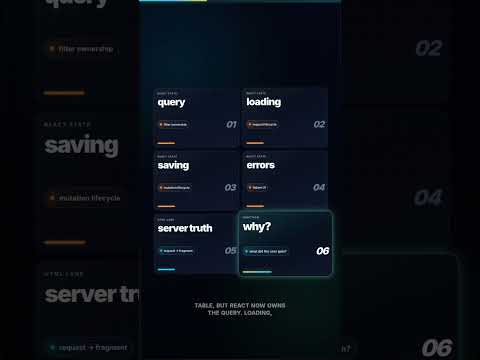
React added 7 packages and 146 KB to a CRUD table that already worked without either. That does not make React a mistake. It makes it a cost that should earn its place. Use HTML-first when the server owns normal forms, tables, filters, and CRUD. Choose React when the browser genuinely owns realtim

HTTP/3 was not built because HTTP/2 failed. It was built because HTTP/2 still sat on TCP, and one lost packet could delay unrelated streams behind it. This short walks through: - why HTTP/1.1 needed many parallel TCP connections - what HTTP/2 actually fixed with multiplexing - why TCP ordering sti

Rust used 5.6 MB. Go used 16 MB. The screenshot made Rust look like the obvious winner. Then 500 concurrent users arrived. Same CRUD API. Same PostgreSQL database. Same routes and request mix. Two fresh runs per cell. Go: 2,615 requests per second at 387 ms p95. Rust: 2,036 requests per second

This React CRUD screen gave me the same result with seven extra packages. This short compares the same contacts board built two ways: - Go + server-rendered HTML + HTMX - React on the same backend contract What stays the same: - same rows - same create flow - same filter result What changes: - de

Most teams choose a stack from one headline number. This channel tests what happens when the load gets real: latency, throughput, memory, cloud cost, reliability, and developer time. We benchmark languages, frameworks, infrastructure, and AI workflows so you can see the trade-offs before production

Microsoft's Go rewrite of TypeScript sounds like a 10x story. On this repo, the measured result was narrower and more useful: about 4.4x faster on the compile path. This short covers: - the real TS 6 vs TS 7 wall-time result on one production-style workspace - the compiler-reported memory change -

Fast APIs can still lose in production. In this short, the benchmark verdict flips once we stop trusting accepted traffic and start measuring completed work, Kafka lag, and tail latency. Spring drained the queue. Go and .NET accepted traffic, but left debt behind under pressure. Watch the full lo

The fastest backend on the chart still lost the production verdict. This short shows why raw throughput is not enough to pick a backend stack. In this video: - C# wins raw speed - Go wins the actual payoff score - Rust stays the efficiency specialist - memory and startup change the final decision

Same microservice. Same database. Same read endpoint. Three very different throughput curves. Verified read throughput: - Go: 28,945 to 29,068 to 28,916 RPS - Rust: 11,364 to 11,024 to 11,349 RPS - ASP.NET: 24,474 to 14,055 to 14,159 RPS Go stayed flat across c=50, c=200, and c=500. Rust stayed st

We built the same HTTP API in four runtimes and measured final container image size with Podman on Apple M4. - Rust (scratch): 3.5 MB - Go (scratch): 5.65 MB - Python (Alpine): 53.4 MB - Node.js (Alpine): 163 MB Rust is 47x smaller than Node. Every pull, every deploy, every cold start in your clus
51 videos total