Videos
Software benchmarks, systems deep-dives, and technical commentary. Subscribe on YouTube

Node.js just ate 465 MB for the same API that Rust runs in 18 💀 same server, same endpoint, same machine. multiply by 100 instances and tell me memory doesn't matter.

One chart is not enough for a production stack decision. Rust Won. Then Lost. Then .NET Won. In this video: what each runtime/language wins where tail latency changes the decision how to pick based on your real bottleneck Watch the full breakdown on the channel for benchmark method, tradeoffs, an

Is your IDE lagging? It's probably Docker Desktop eating 200MB of RAM just to stay idle. Podman is the mathematically superior choice for 2026: ✅ 0MB Idle RAM (Daemonless) ✅ 30% Faster Startup ✅ Native Kubernetes Pods ✅ Rootless security by default Mathematically superior. No contest. **Tags:**

Bun just merged PR #30412, officially moving from Zig to Rust. 750,000 lines of code ported in just 6 days using Claude Code and Robo-Bun. This isn't just a rewrite—it's the first major agentic runtime migration. #Bun #RustLang #ZigLang #AI #Coding #TechNews #SoftwareEngineering
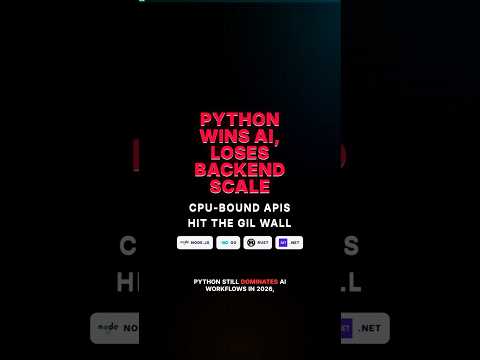
Python is still the default for AI workflows in 2026. But when API traffic turns CPU-heavy, the GIL becomes the bottleneck and tail latency gets ugly. This short breaks down: - why CPU-bound Python services struggle under burst load - where Go and Rust hold better throughput and latency stability -

This short gives the headline from our 2026 Rust vs Go vs .NET microservice benchmark. Completed lanes summary: - Go leads throughput - Rust leads extreme p99.9 tails - .NET AOT lane is still pending stable completion Before choosing a production stack, watch the full longform breakdown for benchma

GraphQL looks elegant on the surface, but at scale the schema can become a real security and performance problem. Deep queries, introspection exposure, resolver explosions, and weak authorization patterns can turn one clean endpoint into a serious backend risk. In this video, I break down why Graph

We spent 10 years perfecting the "slow" web. Massive JSON payloads, hydration errors, and micro-frontend mazes. It's time to go back to basics. Here is how PHP with Swoole and HTMX outperforms modern SPAs and saves you massive cloud costs. Don't be a cost center. Be a Garbage Destroyer. 🗑️🔥 #we

Rust abstractions look high-level, but compile into low-level machine code with near-C++ performance. Here's the proof through assembly, LLVM, and runtime metrics. #rust #systemsprogramming #performance #llvm #softwareengineering

Quick walkthrough of the benchmark repo structure: implementations, scripts, artifacts, and the wrk workload file used for fair comparison. Re-run it yourself: GitHub link in description. #shorts #zig #rust #cplusplus #backend #benchmark #opensource

Code-level proof cut: same routes, same schema, same wrk workload. Rust wins RPS, Zig wins p99, and C++ wins footprint in this run. Full repo and artifacts: GitHub link in description. https://github.com/prod-garbage-destroyer/zig-rust-cpp-cloud-v1 #shorts #zig #rust #cplusplus #backend #benchmark

Same API, same workload, same environment. Rust leads throughput, Zig leads p99 latency, C++ leads footprint. Full benchmark and code: GitHub link in description. https://github.com/prod-garbage-destroyer/zig-rust-cpp-cloud-v1 #shorts #zig #rust #cplusplus #backend #benchmark #cloud
51 videos total